Why Does the Ocean Feel Like a Reset for My Whole Being
The moment my feet touch sand, something in me softens.
It can happen before I even see the water. The air changes first. Salt sits on my skin. The wind moves differently. The sound of the waves reaches me before the shoreline does, steady and familiar, like a breath I had forgotten how to take.
Then I see it.
The ocean does not ask me to hurry. It does not ask me to prove anything, perform anything, achieve anything, or be anywhere other than here. For a moment, the pressure lifts. The noise of the world fades back. My body remembers that it is allowed to unclench.
By the sea, I feel calm. Relaxed. Held.
Like the whole world has paused for a moment and let me go.

The ocean gives the body permission to slow down
So much of daily life pulls us forwards.
There is always something to answer, finish, plan, fix, improve, or compare. Even rest can start to feel like another thing to do properly. We carry that pressure in our shoulders, our jaw, our breath, our belly, our thoughts.
At the ocean, that changes.
The sea moves in rhythms that are older than our schedules. Waves arrive, break, draw back, and return. Again and again. There is no rush in it, even when the water is wild. It has a pattern the body can feel before the mind understands it.
That rhythm invites a different pace.
I breathe more deeply by the water. Not because I have told myself to “relax”, but because my body seems to know what to do. My chest opens. My feet connect with the ground. My thoughts stop racing quite so loudly.
The ocean gives me something simple to follow:
The wave comes in.
The wave goes out.
The breath comes in.
The breath goes out.
That is enough.
For a little while, I do not need to compete with anyone. I do not need to keep up. I do not need to be impressive. I can walk, float, stretch, swim, sit, or simply stand there with my toes in the wash.
There is something powerful about being reminded that life does not always have to be pushed.
Sometimes it can move through us.
Every sense is invited back into the present
One reason the ocean feels so calming is that it brings me back into my senses.
Not in a forced way. Not by trying to think my way into mindfulness. The beach does it gently. It gives the mind somewhere real to land.
There is the smell of salt and seaweed in the air. The feeling of sand beneath my feet, warm and grainy near the dunes, cool and packed closer to the tide. There is the shock of water around my ankles. The sound of waves folding into themselves. The glitter of light on the surface. The wind lifting hair from my face.
These small details matter.
They pull attention away from the endless scroll of thoughts and back into the body. Back into now. Back into what is real and touchable.
When I am diving through waves, I feel fully alive. There is no room to overthink when water surrounds me. I have to meet the wave as it comes. I duck under, come up, laugh, wipe salt from my eyes, and feel my heart beating.
When I am surfing, the ocean asks for focus. I cannot be halfway there. I am reading the water, feeling the board, waiting, paddling, rising, falling. Whether I catch the wave or miss it, I am present.
When I roll out a mat for yoga on the sand, the ground is uneven. My balance changes. My hands press into tiny shells and soft grains. The breeze touches my skin. A simple forward fold feels different there. Less like a shape to achieve and more like a bow to the earth.
Even dipping one toe into the wash can be enough.
The body gets the message: come back here.

The sea lets me stop performing
There is a kind of exhaustion that comes from always being watched, measured, or compared.
It is not always obvious. It can hide under ambition, responsibility, caring for others, or simply trying to keep life together. We move through the week holding ourselves tightly. We become used to effort. Used to bracing. Used to proving that we are capable.
Then the ocean arrives with another way of being.
The sea is vast, but it does not make me feel small in a cruel way. It makes my worries feel less sharp. It reminds me that I am part of something much bigger than my inbox, my plans, my doubts, or my need to get everything right.
That shift feels like relief.
The ocean does not care what I look like in a wetsuit. It does not care how flexible I am in a yoga pose. It does not care whether I fall off the board, whether my hair is tangled, whether my breathing is messy, whether I have been productive enough this week.
It just keeps moving.
There is comfort in that.
By the water, I feel free to be unpolished. I can be quiet. I can be playful. I can be tired. I can be strong one minute and soft the next. I can let the waves knock me over and still come up smiling.
That freedom is part of the reset.
It is not only about feeling calm. It is about feeling released from the constant pressure to be more than human.
Why does the ocean feel like a reset for my whole being
For me, the answer lives in the whole experience.
It is the rhythm of the waves. The space of the horizon. The salt air. The movement. The cool water. The sand underfoot. The way the body wakes up and settles down at the same time.
The ocean speaks to the nervous system in a language older than words.
That does not mean the sea fixes everything. It does not erase grief, stress, deadlines, or the hard parts of being alive. But it can create a gap. A pause. A moment where the body no longer feels trapped inside the speed of ordinary life.
That pause can be deeply healing.
Not in a dramatic way. More like an exhale you did not realise you were holding.
When I say my nervous system feels reset, I mean I feel less clenched. I feel less on alert. I feel like I can take a fuller breath. I feel like my body has stopped scanning for what comes next and has started trusting the moment it is in.
That is a rare feeling.
And once I recognise it by the ocean, I start to crave it elsewhere too. Not as an escape, but as a way of returning to myself.
We cannot always get to the beach
As much as I love the sea, real life does not always place us beside it.
Some days, the beach is hours away. Some seasons are full. Some mornings are too cold, too dark, too busy, or too crowded with responsibilities. We cannot all step into the waves whenever we need the world to quieten down.
But the feeling the ocean gives us can teach us something.
It shows us that pauses are not luxuries. They are necessary.
We need moments where the body can stop bracing. We need spaces where breath becomes deeper, movement becomes kinder, and the mind can settle. We need reminders that we are not machines built to produce, compete, and keep going without end.
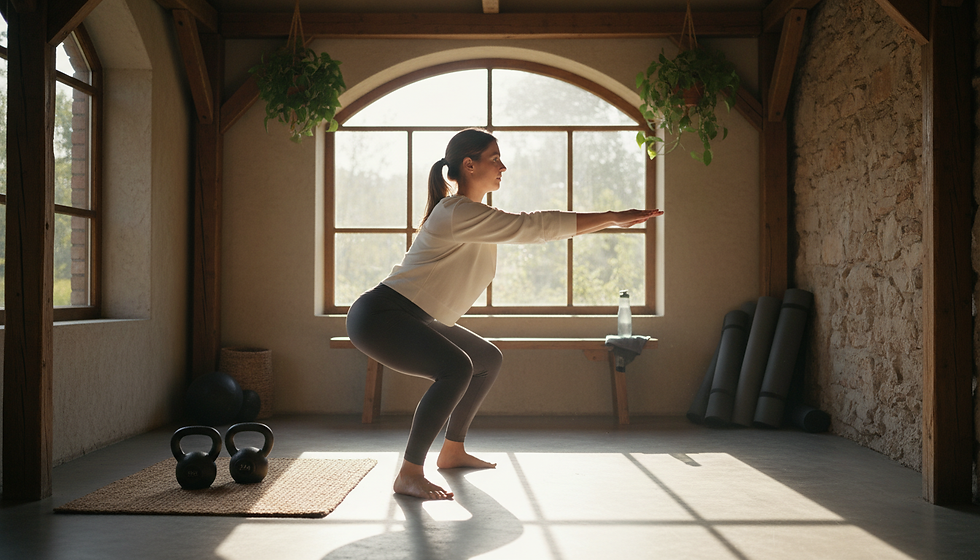
Yoga and movement can become one way to create those pauses wherever we are.
Not as a replacement for the ocean, because nothing truly replaces the sea. But as a doorway into the same kind of listening.
A yoga mat on the living room floor can become a shoreline of its own. A slow stretch can feel like a wave moving through the spine. A child’s pose can feel like coming back to the sand. A flowing practice can carry the same rise and fall as the tide.
The pause is the point.
Not the perfect pose. Not the strongest body. Not the longest practice. The pause.

Movement can become its own tide
When I practise yoga with the ocean in mind, I stop treating movement as another task.
I let it become tidal.
There is an opening and closing. A reaching and returning. A softening and strengthening. A moment of effort, then a moment of rest. The body starts to remember that it does not have to stay in one state all day.
This can be simple.
A few slow shoulder rolls while standing barefoot. A forward fold with bent knees. A gentle twist on the floor. A hand over the heart and one hand on the belly. Three breaths where nothing needs to be fixed.
These small movements can change the tone of a day.
They bring attention back to sensation. They help us notice where we are holding tension. They create a small space between the world’s demands and our response to them.
That space matters.
It is where we get to choose softness instead of force. It is where we hear the body before it has to shout. It is where we remember that rest is not earned only after collapse.
The ocean teaches this beautifully. Waves do not only crash. They also retreat. They gather. They pause. They return.
We are allowed to do the same.
A simple ocean-inspired pause
When I cannot get to the beach, I like to borrow the feeling of it.
This is not complicated. It does not need candles, music, a perfect room, or a full hour. It can take a few minutes. The simpler it is, the more likely I am to do it.
Try this as a small reset:
Stand or sit with both feet grounded
Feel the contact beneath you. Imagine sand under your feet, steady and supportive.
Soften your jaw and shoulders
Let your face loosen. Let your shoulders drop away from your ears.
Breathe like the tide
Inhale gently, as if the wave is coming in. Exhale slowly, as if the wave is drawing back.
Move with the breath
Raise your arms as you breathe in. Lower them as you breathe out. Keep it slow and easy.
Pause before you continue
Let yourself notice the effect. Even one quiet breath counts.
This kind of practice seems small, but small pauses can be powerful when we repeat them. They remind the body that calm is not only found somewhere far away. It can be invited in, breath by breath.
Of course, some days the mind stays busy. Some days the body feels restless. That is not failure. The ocean is not still every day either.
The practice is simply to return.
The reset is not a luxury
The world often treats rest as something extra.
Something to squeeze in after the work is done. Something we can have once everything is under control. Something we must justify with productivity before and after.
But the ocean tells a different story.
It reminds me that pausing is part of being alive. Breathing deeply is part of being alive. Moving in a way that feels kind rather than punishing is part of being alive. Letting the nervous system settle is not indulgent. It is basic care.
When I am by the sea, I remember what it feels like to belong to my own body.
That feeling should not be rare.
We may not always be able to run to the beach, dive through waves, surf until sunset, or practise yoga with salt on our skin. But we can still create little shorelines in the middle of ordinary life.
A breath before opening the next message.
A stretch between tasks.
A walk without headphones.
A hand on the heart.
A slow exhale.
A moment of stillness where we stop competing with the world and let ourselves be.

The ocean feels like a reset because it brings me back to what is simple and true.
I am here. I am breathing. I do not have to rush this moment. I do not have to prove my worth. I can soften. I can move. I can begin again.
And when life gets loud, that is what I want to remember.
The pause is not a luxury.
It is necessary.


Comments